- Home to LMIC
- Virtual Labor Market Data System
- Career Exploration & Planning
- Consumer Price Index
- Demographics
- Economic Snapshot
- Employee Benefits
- Employment Projections
- Labor Force & Unemployment
- Labor Supply
- Overview of the Current Labor Market
- Surveys We Conduct
- Wages & Income
- Workers by Industry
- Tools & Resources
- Publications
- References
- What's New
- Can't Find It?
Labor Market Information Center
2025 Annual Report
Quarterly Census of Employment and Wages
Public Administration Supersector
NAICS Sector 92
The Public Administration supersector contains information on Federal, State and Local Governments. Tribal governments are included in local government. A change in federal law requires Indian tribes to be classified similarly to state and local governments.
| South Dakota Covered Workers and Pay 2025 |
|||
| Supersector, Sector | Number of Establishments | Average Number of Workers | Annual Pay |
| Public Administration | 2,399 | 76,608 | $56,474 |
| Federal Government | 689 | 11,378 | $88,536 |
| Federal Government | 689 | 11,378 | $88,536 |
| State Government | 796 | 14,835 | $68,426 |
| State Government Education | 13 | 5,790 | $68,275 |
| State Government, excluding Education | 783 | 9,045 | $68,524 |
| Local Government | 872 | 50,284 | $48,396 |
| Local Government Education | 231 | 27,467 | $47,266 |
| Local Government, excluding Education and Tribal Government | 566 | 15,263 | $50,595 |
| Local Tribal Government, excluding Education | 43 | 5,671 | $46,585 |
| Local Tribal Government Education | 32 | 1,883 | $52,512 |
| See summed data for Local Tribal Government. Totals may not add due to rounding. Data subject to revision. Produced by the Labor Market Information Center, South Dakota Department of Labor and Regulation, in cooperation with the U.S. Bureau of Labor Statistics. |
|||
Federal Government
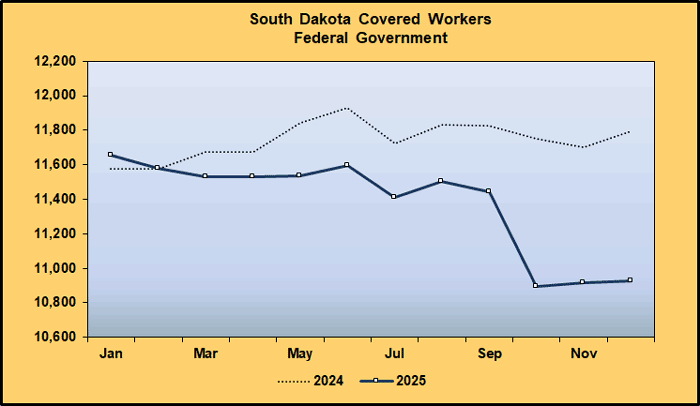
The number of Federal Government workers decreased by 364 (3.0%) from 2024 to 2025 to a new total of 11,378. Federal government establishments had a $3,322 (3.9%) increase in annual pay for a new level of $88,536. This remains one of the highest paying industries in South Dakota.
Federal government is a composition of government that distinguishes power between a strong, larger central government and smaller local and state governments and remains integrated to one another by the federal government. The federal government sometimes is simply referred to as “Washington” and has three distinct branches: legislative, judicial, and executive, whose powers are vested by the U.S. Constitution in the congress, federal courts, and the president, respectively. Some areas of public life are under the control of the national government, and some areas are under control of local governments. The constitution stipulates what areas of public life the federal government has control over and what areas of public life state governments regulates. Ideal examples of federal governments are those that function best in large countries where there exist wide-ranging diverse groups of people with unique needs with a common culture. Thus, the federal government helps to address the wide multiplicity of needs of a geographical area. Only the federal government can regulate interstate and foreign commerce, declare war, set taxing, spending and other national policies.
Federal worker levels in Administration of Human Resource Programs agencies for the past several years have experienced an increase. During 2025 the final calculation was 28 additional workers. The new total of workers is now 831. Annual pay had an increase of $2,990 to settle at $98,828 for the new annual average. This category is characterized by government establishments involved in administration of educational, public health, and veteran affairs programs. Public health programs and services require workers to carry out health activities, health statistics, mental health assistance, and immunization program services. Veterans Affairs offices and benefits program administration often supply assistance, training, counseling, and other services to veterans and their dependents or survivors. Veterans Affairs offices help maintain and coordinate activities with other service organizations and governmental agencies.
There was a decrease of federal workers within the Administration of Environmental Quality Programs. This grouping realized a loss of 48 workers in 2025, with the total now 1,013. Most of the losses were within the administration of conservation programs, offsetting last year’s gains for these same programs. These agencies are primarily engaged in administration, regulation, supervision, and control of land use. Included are recreational areas, conservation and preservation of natural resources, weather forecasting administration, and the protection of public and private owned forest lands. This industry also incorporates agencies responsible for management and regulation of game, fish, and wildlife populations including management areas and field stations.
The Administration of Economic Programs agencies registered a decrease of 39 workers throughout 2025. Government agencies plan, administer, and coordinate agricultural programs for production, marketing, and utilization, including educational and promotional activities. These public agencies are dedicated to promoting economic growth, business development, and regional competitiveness. Examples are agricultural cooperative extension programs and agricultural marketing services. Offsetting some of the decreases in workers were some employment gains in regulatory and safety transportation programs.
State Government
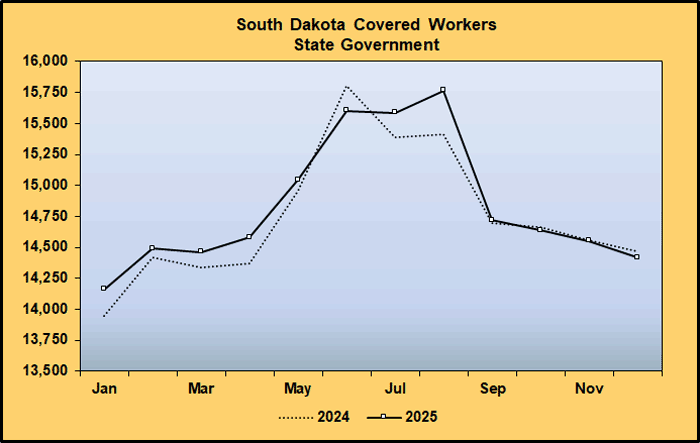
Worker numbers in State Government increased by 82 workers from 2024 to 2025 for a new total of 14,835, 0.6% growth. State government employment has had minor increases or decreases spread out amongst several agencies over the past few years. Annual pay in state government increased to a new average of $68,426 in 2025, a 1.6% growth rate over 2024.
State government is a component of government that uniquely makes and enforces laws for a state. State government is modeled after the Federal government and consists of three branches: executive, legislative, and judicial. The U.S. Constitution mandates that all states uphold a form of government, although the three-branch structure is not required. State governments administer to the local needs of an area. State governments have certain reserved powers, specific authority, and responsibilities that the national government does not have. In general, state governments are responsible for regulating trade within state borders and for establishing regulations for local corporations. State governments also administer to the needs of the many smaller local governments by establishing charters for county and city government. State governments play a dynamic role in regulating the educational system of their states and establishing licensing rules for professionals who practice in the state. State government exercises essential functions in the United States. They are responsible for governing the local needs and problems of the state. The state constitution usually stipulates what powers and responsibilities state government has. They propose, strategize, and pay for most roads, operate public schools, provide water, establish zoning regulations, arrange elections for their citizens and prepare policy.
The Justice, Public Order, and Safety Activities subsector contains government establishments engaged in the administration of justice, public order, and safety programs. These agencies experienced some worker additions during 2025. This cluster grew by 57 workers or 2.8%. There are now 2,072 employees working in these establishments. Annual wages also increased by 1.2%, gaining $864 to close out at $71,633 for the year. Correctional institutional government establishments are engaged in managing and operating facilities. These facilities are generally designed for the confinement, correction, and rehabilitation of adult and/or juvenile offenders sentenced by a court, while ensuring public safety. Additional workers are needed to provide secure, safe environments with rehabilitation programs, including education, vocational job training, and mental health services.
Executive, Legislative, and Other General Government Support groups of government offices experienced some increases of workers during 2025. This grouping grew by 23, 3.2% growth. These public agencies have core public administration functions and are responsible for policy development, leadership, oversight, and administrative backbone. These government establishments provide essential administrative, executive, and legislative functions. It encompasses executive offices, legislative bodies, public finance, and other general government support. These agencies have various functions and advisory capacities and support public programs and other government agencies.
Educational Services also gained employment during 2025. Tallying up the numbers resulted in 55 new workers. There are now 5,790 employees working in the educational field. Annual pay recorded a gain as well, reaching $68,275. Higher education provides instruction and training in a wide variety of subjects and with an assortment of program offerings. People continue to realize the importance of education as both undergraduate and graduate degrees can be achieved through higher education. There are many options for students to choose, and with flexible education programs now being offered, educators and staff are being added to the payrolls. Instructors are needed to provide services in a wide variety of settings to help students earn degrees at baccalaureate or graduate levels.
Local Government
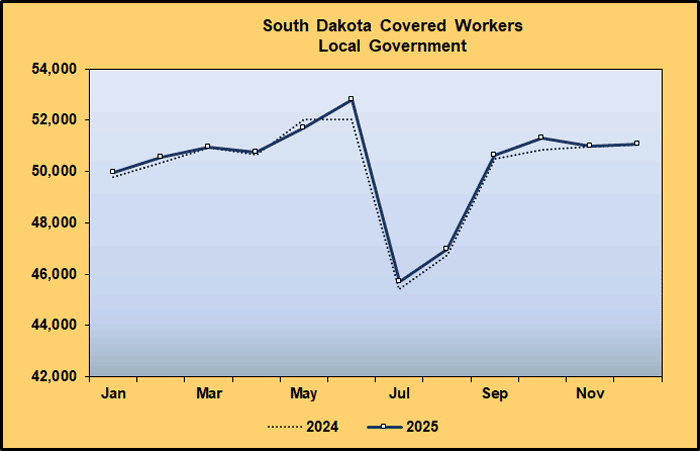
Local Government worker levels increased by 171 or 0.3% from 2024 to 2025 for a new figure of 50,284 employees. Worker growth in the past five years have made up for losses in 2020. Local government displayed a $1,854 or 4.0% increase in annual pay for a new level of $48,396 during 2025.
Local Government is an administrative body for a slighter-scale geographic area, such as a city, town, county, or district. Local governments are institutional units whose fiscal, legislative, and executive authority extends over the smallest geographical areas distinguished for administrative and political purposes. It refers to the operations of corporations, municipalities, district boards, and other bodies that are entrusted with the execution of functions relating to and concerning the residents of a given locality. Local governments extract their authority from the state in which they are located. Local governments routinely have control over their exclusive geographical region and cannot pass or enforce laws that will affect a wider area. Local governments can elect officials, enact taxes, and do many other things that a national government would do, but on a smaller scale. The authorities contracted to local governments originate from the state in which they are localized and from the state constitution.
Educational Services experienced a worker expansion throughout 2025. This industry gained 221 workers, finishing the year at 27,467 for growth of 0.8%. Annual pay increased to $47,266, a 2.4% gain over 2024. Elementary and secondary schools involved in delivering academic courses and associated course work that encompass a basic preparatory education multiplied its worker levels, comparable to last year’s gains. These schools correspond to a recognized series of formal levels of education designated by diplomas. Establishments provide instruction and training in a wide selection of subjects. Colleges, Universities, and Professional Schools revealed worker level expansion. These colleges and professional schools may provide instruction in diverse settings, such as the establishments or client’s training facilities, educational institutions, or the workplace. Training may be delivered through diverse means, such as the Internet, or other electronic and distance-learning methods. Classrooms are occupied and schools are staffed accordingly to provide teaching and extra curriculum activities. Educational services with its workforce make up more than 50% of all the workers for local government. Local government plays a key role in public education in South Dakota and throughout the United States from kindergarten to advanced college. Local Government provides primary funding for public schools, using money largely raised through state and local taxes.
The public administration subsector Executive, Legislative, and Other General Government Support produced gains of 164 workers in 2025. Executive and Combined Legislative Offices noted these increases in employees. For the past six years notable employee increases have been the case. Annual wages rose by $2,774 for a new annual average of $50,933. Executive and legislative office combinations belong in this group. This industry includes councils, boards of commissioners, and legislative bodies. These types of offices offer planning, coordination, and technical assistance. They also oversee programs at a regional level and can act as intermediaries between local government and the state or federal government. Other general government support agencies generally refer to behind-the-scenes administrative operations, along with services essential for government functionality. Public property management services and purchasing and supply agencies provide valuable services such as procurement of equipment and supplies so business operations can be maintained. It is important to remember that tribal government has been included in Local Government since 2001.
The remaining local public administration subsectors yielded little or no change in employment levels in 2025. This includes Justice, Public Order, and Safety Activities; Administration of Human Resource Programs; Administration of Environmental Quality Programs; Administration of Housing Programs; Urban Planning, and Community Development; and Administration of Economic Programs. Apart from Administration of Environmental Quality Programs, the remainder of these agencies have diminutive levels of workers. All these agencies and administrations are essential and viable as they provide an array of services and support. They are engaged with coordinating, planning, and supervising policies for their respective centralized programs.