- Home to LMIC
- Virtual Labor Market Data System
- Career Exploration & Planning
- Consumer Price Index
- Demographics
- Economic Snapshot
- Employee Benefits
- Employment Projections
- Labor Force & Unemployment
- Labor Supply
- Overview of the Current Labor Market
- Surveys We Conduct
- Wages & Income
- Workers by Industry
- Tools & Resources
- Publications
- References
- What's New
- Can't Find It?
Labor Market Information Center
2025 Annual Report
Quarterly Census of Employment and Wages
Education and Health Services Supersector
The Education and Health Services supersector is comprised of the Education Services sector and the Health Services and Social Assistance sector. Businesses within this supersector provide instruction and training or provide health care and social assistance to individuals.
| South Dakota Covered Workers and Pay 2025 |
|||
| Supersector, Sector and Subsector | Number of Establishments | Average Number of Workers | Annual Pay |
| Education and Health Services | 3,824 | 75,643 | $68,899 |
| Educational Services | 570 | 3,998 | $36,390 |
| Educational Services | 570 | 3,998 | $36,390 |
| Health Care and Social Assistance | 3,254 | 71,645 | $70,713 |
| Ambulatory Health Care Services | 2,046 | 20,778 | $92,791 |
| Hospitals | 74 | 28,573 | $79,399 |
| Nursing and Residential Care Facilities | 336 | 13,013 | $42,795 |
| Social Assistance | 798 | 9,280 | $33,692 |
| Totals may not add due to rounding. Data subject to revision. Produced by the Labor Market Information Center, South Dakota Department of Labor and Regulation, in cooperation with the U.S. Bureau of Labor Statistics. |
|||
Educational Services
NAICS Sector 61
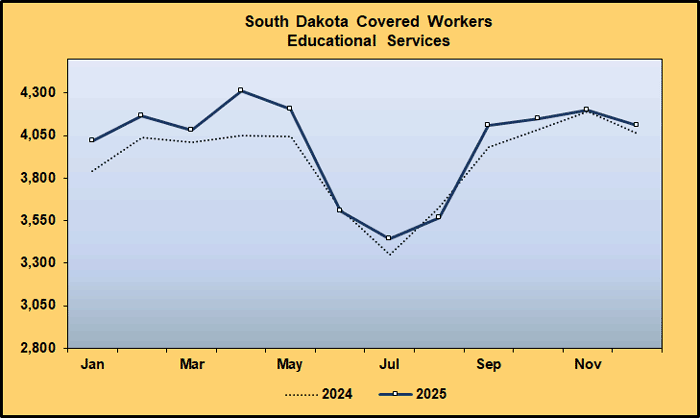
In 2025, the private Educational Services sector gained 90 workers (2.3%). The employment level was 3,998. The annual wage increased $419 (1.2%) from 2024 to 2025 to a new average of $36,390.
The Educational Services sector is made up of establishments that provide instruction and training in a wide variety of subjects. This instruction and training is provided by specialized establishments, such as schools, colleges, universities, and training centers. Educational services are usually delivered by teachers or instructors who explain, tell, demonstrate, supervise, and direct learning. Instruction is imparted in diverse settings, such as educational institutions, the workplace, or even the home and through diverse means, such as correspondence, television, the internet, or other electronic and distance learning methods.
The training provided by these establishments may include the use of simulators and simulation methods. It can be adapted to the needs of the students. For example, sign language can replace verbal language for teaching students with hearing impairments. All industries in the sector share this commonality of process, namely labor inputs of instructors with the requisite subject matter expertise and teaching ability. These establishments may also offer food and accommodation services to their students.
Educational Services is comprised of only one subsector, also named Educational Services. Within the subsector are the following industry groups:
- Elementary and Secondary Schools (NAICS 6111)
- Junior Colleges (NAICS 6112)
- Colleges and Universities (NAICS 6113)
- Business, Computer, and Management Training (NAICS 6114)
- Technical and Trade Schools (NAICS 6115)
- Other Schools and Instruction (NAICS 6116)
- Educational Support Services (NAICS 6117)
Significant employment gain occurred in Elementary and Secondary Schools and Other Schools and Instruction. The remaining industry groups saw only small employment gains in 2025.
Establishments in the Elementary and Secondary Schools industry group are primarily engaged in furnishing academic courses and associated course work that comprise a basic preparatory education, generally kindergarten through high school.
Establishments in the Other Schools and Instruction industry group provide instruction in diverse settings. Fine arts schools, sports and recreation instruction, and language schools belong to this industry group.
The Educational Services sector is widely considered counter-cyclical. Typically, when the economy is doing well and unemployment is at a very low rate, more working adults decide to go to work. More career and job prospects available for working adults, in turn, leads to lower enrollment, decreased profit, and a lower need for teachers/instructors at schools.
Establishments in this sector are privately owned and operated for profit or not for profit. Publicly owned establishments, usually owned and operated by state and local governments, are not included in this analysis. Statistics for those types of establishments are analyzed under the Public Administration supersector. Roughly 11% of the employment in Education Services falls in privately owned establishments, with the rest being in publicly owned establishments.
Health Care and Social Assistance
NAICS Sector 62
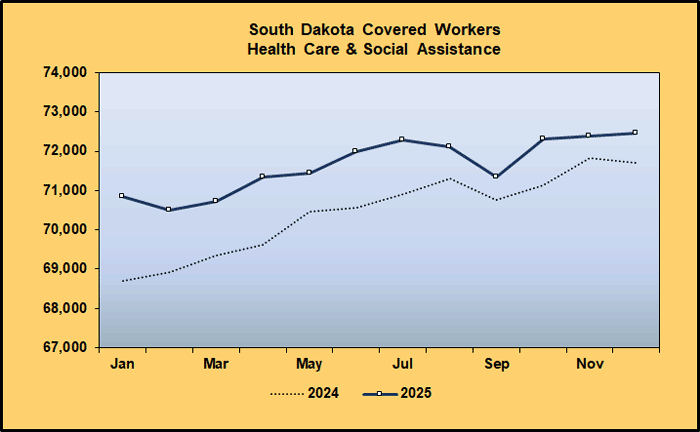
The Health Care and Social Assistance sector grew once again in 2025. Both employment and wages increased from 2024. Compared to other sectors, this sector has the highest amount of employment and largest amount of total wages paid out in South Dakota.
The number of workers reached 71,645, growing 1.7% from 2024. Average annual wages increased $3,441 (5.1%) to $70,713. This sector includes both health care and social assistance, because sometimes it is difficult to distinguish between the boundaries of these two activities. The Health Care and Social Assistance sector is made up of four subsectors.
- Ambulatory Health Care Services (NAICS 621)
- Hospitals (NAICS 622)
- Nursing and Residential Care Facilities (NAICS 623)
- Social Assistance (NAICS 624)
The Ambulatory Health Care Services subsector’s employment grew 3.3% to 20,778 in 2025. The annual average wage was $92,791, which is the highest out of all four subsectors. Establishments provide health care services directly or indirectly to ambulatory patients and do not usually provide inpatient services. Employment gains were distributed evenly through most of the industry groups. The largest employment gain, percentage-wise, was seen in Outpatient Care Centers. This industry group comprises establishments with medical staff primarily engaged in providing a range of outpatient services, such as family planning, diagnosis and treatment of mental health disorders, and alcohol and other substance abuse, and other general or specialized outpatient care.
The Hospitals subsector is comprised of establishments providing medical, diagnostic, and treatment services that include physician, nursing, and other health services to inpatients and the specialized accommodation services required by inpatients. Hospitals may also provide outpatient services as a secondary activity. These establishments provide inpatient health services, many of which can only be provided using the specialized facilities and equipment that form a significant and integral part of the production process.
Some of the largest establishments in South Dakota belong to the Hospitals subsector. The number of workers in 2025 decreased slightly by 0.4% to 28,573. This subsector’s average annual wage increased $4,425 (5.9%) to $79,399.
The Nursing and Residential Care Facilities subsector had employment increases for the third year in a row. Worker levels grew 4.7% to 13,013. The annual average wage grew 5.8% to $42,795. This subsector’s establishments provide residential care combined with either nursing, supervisory, or other types of care as required by the residents. Examples of facilities included in this subsector are nursing homes which have a permanent core staff of nurses along with other staff to provide nursing and continuous personal care services. Assisted and unassisted continuing care retirement community facilities are also part of this industry. Some of the residents need some nursing and personal care while others need limited services because they do not desire to live independently, so nursing care is not as vital. Care typically includes room, board, supervision, and assistance in daily living, such as housekeeping services. Demand for this type of care is high in South Dakota.
The Social Assistance subsector’s employment level increased by 77 workers (0.8%) to 9,280. Establishments provide a wide variety of social assistance services directly to clients. Employment growth can be attributed mostly to Vocational Rehabilitation Services and Child Care Services. Establishments within Child Care Services provide care and learning opportunities for infants and children. As the population grows the need for care workers becomes a need.