- Home to LMIC
- Virtual Labor Market Data System
- Career Exploration & Planning
- Consumer Price Index
- Demographics
- Economic Snapshot
- Employee Benefits
- Employment Projections
- Labor Force & Unemployment
- Labor Supply
- Overview of the Current Labor Market
- Surveys We Conduct
- Wages & Income
- Workers by Industry
- Tools & Resources
- Publications
- References
- What's New
- Can't Find It?
Labor Market Information Center
2025 Annual Report
Quarterly Census of Employment and Wages
Financial Activities Supersector
The Financial Activities supersector is comprised of the Finance and Insurance sector and the Real Estate and Rental and Leasing sector. Businesses within this supersector are involved in financial transactions or renting or leasing tangible or intangible assets.
|
South Dakota Covered Workers and Pay 2025 |
|||
| Supersector, Sector and Subsector | Number of Establishments | Average Number of Workers | Annual Pay |
| Financial Activities | 4,441 | 26,915 | $88,966 |
| Finance and Insurance | 2,985 | 22,360 | $95,683 |
| Credit Intermediation and Related Activities | 972 | 13,546 | $90,555 |
| Securities, Commodity Contracts, and Investments | 559 | 1,747 | $161,470 |
| Insurance Carriers and Related Activities | 1,397 | 6,956 | $89,255 |
| Funds, Trusts, and Other Financial Vehicles | 57 | 111 | $88,948 |
| Real Estate and Rental and Leasing | 1,456 | 4,555 | $55,993 |
| Real Estate | 1,289 | 3,670 | $55,258 |
| Rental and Leasing Services | 155 | 834 | $56,450 |
| Lessors of Nonfinancial Intangible Assets | 12 | 52 | $99,454 |
| Totals may not add due to rounding. Data subject to revision. Produced by the Labor Market Information Center, South Dakota Department of Labor and Regulation, in cooperation with the U.S. Bureau of Labor Statistics. |
|||
Finance and Insurance
NAICS 52
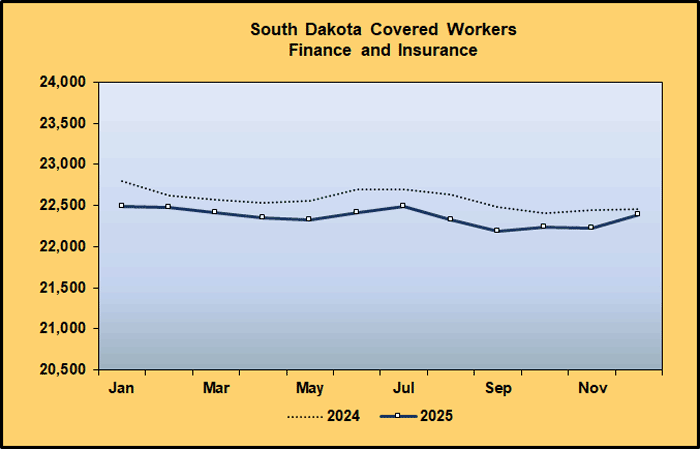
The Finance and Insurance sector saw a loss of 215 workers (1.0%) in 2025 for average employment of 22,360. Average annual pay increased to $95,683 from $90,089. This sector ranks third and sixth in average annual wage and average employment, respectively.
The Finance and Insurance sector establishments are primarily engaged in financial transactions and/or facilitating transactions by three principal types of activities. The first activity is to raise funds by taking deposits or issuing securities and incurring liabilities. The second activity is to pool risk by underwriting insurance and annuities. The last activity is to provide specialized services facilitating or supporting financial intermediation, insurance, and employee benefit programs.
The number of workers in the Credit Intermediation and Related Activities (NAICS 522) subsector decreased for the 12th consecutive year. Average annual employment in 2025 was 13,546, decreasing 2.9%. Average annual pay increased $4,259 (4.9%) to $90,555. Establishments within this subsector lend funds raised from depositors or from credit market borrowing and facilitate the lending of funds or issuance of credit. The transition to online services within this subsector has likely contributed to the downward trend. The use of advanced technology has led to the shift from traditional banking methods to modern banking methods. Currently, the most common and useful technology-based banking methods are online banking, mobile banking, video banking, telephone banking, ATMs, and plastic money. Internet banking has made life simple and convenient because of efficiency. Internet is a cheap delivery channel for banking products and is allowing entities to reduce branch networks and downsize the number of service staff.
The Securities, Commodity Contracts, and Other Financial Investments and Related Activities (NAICS 523) saw a significant increase in employment. Average annual employment increased 6.1% to 1,747 in 2025. The average annual wage increased 7.5% to $161,470 in 2025. Most of the subsector’s employment growth is attributable to establishments that participate in customized investment advice, portfolio management, and trust services for customers. Security brokerages and investment banking establishments which act as agents or brokers between buyers and sellers of securities and commodities also saw employment gain in 2025.
After a slight decrease in 2024, employment increased in the Insurance Carriers and Related Activities (NAICS 524) subsector in 2025. From 2024 to 2025, employment rose 1.0% to 6,956. The average annual pay for the year was $89,255, an increase of 7.2%. This subsector includes establishments involved in selling annuities and insurance policies, claims adjusting, and third-party administration of insurance and pension funds.
The Funds, Trust, and Other Financial Vehicles (NAICS 525) subsector employs the least number of workers by a large margin within the Finance and Insurance sector. Employment grew to 111 in 2025, an increase of 26.1%. Establishments in this subsector, which generally only employ one or two employees each, are comprised of legal entities organized to provide insurance and employee benefits or to pool securities and other assets.
Real Estate and Rental and Leasing
NAICS Sector 53
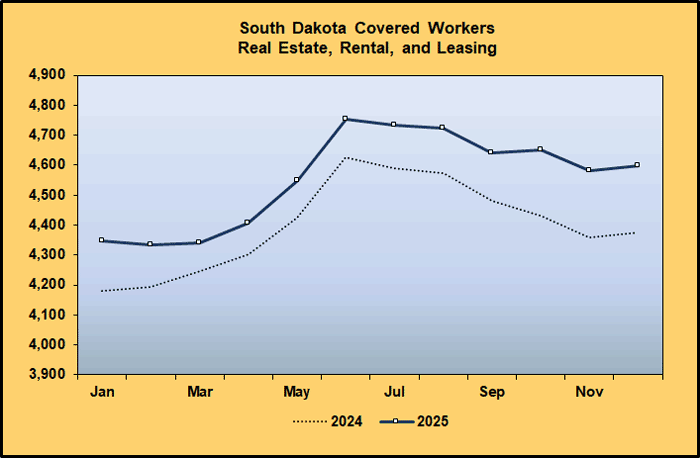
The Real Estate and Rental and Leasing sector gained 156 workers (3.5%) from 2024 to 2025 for an annual average of 4,555. The sector had an average annual pay of $55,993, increasing by $1,021 (1.9%).
The sector is comprised of three subsectors: Real Estate (NAICS 531); Rental and Leasing Services (NAICS 532); and Lessors of Nonfinancial Intangible Assets (NAICS 533). Approximately 80% of workers are employed in the Real Estate subsector.
Employment in the Real Estate subsector continued to grow in 2025 like in previous years. Over the year, the number of workers increased 4.5% to 3,670. There was employment gain in each of the three industry groups; Lessors of Real Estate, Offices of Real Estate Agents and Brokers, and Activities Related to Real Estate. The industry group with the largest employment increase was Activities Related to Real Estate. This industry group includes activities such as property management, real estate appraisers, escrow services, and listing services.
Rental and Leasing Services, a stagnant/declining subsector over the years, hardly changed since 2024 with employment loss of one worker (0.1%) for a total of 834 in 2025. Worker gains were realized within Automotive Equipment Rental and Leasing as well as Commercial and Industrial Machinery Rental and Leasing. The Consumer Goods Rental and General Rental Centers industry groups declined slightly.
The last subsector, Lessors of Nonfinancial Intangible Assets, decreased by two workers to an annual average of 52 in 2025. The subsector contains only itself within its lone industry group. This industry has a very low number of workers, and establishments are mainly engaged in assigning rights to assets such as patents, trademarks, and brand names for which a royalty payment of licensing fee is paid to the asset holder.