- Home to LMIC
- Virtual Labor Market Data System
- Career Exploration & Planning
- Consumer Price Index
- Demographics
- Economic Snapshot
- Employee Benefits
- Employment Projections
- Labor Force & Unemployment
- Labor Supply
- Overview of the Current Labor Market
- Surveys We Conduct
- Wages & Income
- Workers by Industry
- Tools & Resources
- Publications
- References
- What's New
- Can't Find It?
Labor Market Information Center
2025 Annual Report
Quarterly Census of Employment and Wages
Manufacturing Supersector
The Manufacturing supersector contains one sector, Manufacturing. Businesses within this supersector transform materials, substances or components into new products.
| South Dakota Covered Workers and Pay 2025 |
|||
| Supersector, Sector and Subsector | Number of Establishments | Average Number of Workers | Annual Pay |
| Manufacturing | 1,076 | 44,302 | $66,214 |
| Manufacturing | 1,076 | 44,302 | $66,214 |
| Food Manufacturing | 136 | 10,866 | $62,910 |
| Beverage and Tobacco Product Manufacturing | 32 | 320 | $23,296 |
| Textile Mills | 0 | 0 | $0 |
| Textile Product Mills | 20 | 578 | $55,669 |
| Apparel Manufacturing | 5 | 42 | $50,685 |
| Leather and Allied Product Manufacturing | 2 | 10 | $21,213 |
| Wood Product Manufacturing | 57 | 2,121 | $64,460 |
| Paper Manufacturing | 9 | 705 | $70,879 |
| Printing and Related Support Activities | 89 | 1,278 | $54,126 |
| Petroleum and Coal Products Manufacturing | 1 | * | * |
| Chemical Manufacturing | 38 | 1,294 | $81,053 |
| Plastics and Rubber Products Manufacturing | 42 | 1,776 | $66,923 |
| Nonmetallic Mineral Product Manufacturing | 84 | 1,840 | $80,046 |
| Primary Metal Manufacturing | 9 | 611 | $75,137 |
| Fabricated Metal Product Manufacturing | 178 | 4,595 | $63,035 |
| Machinery Manufacturing | 131 | 5,987 | $70,503 |
| Computer and Electronic Product Manufacturing | 33 | 1,666 | $63,018 |
| Electrical Equipment, Appliance, and Component Manufacturing | 13 | 501 | $61,040 |
| Transportation Equipment Manufacturing | 54 | 3,485 | $68,829 |
| Furniture and Related Product Manufacturing | 61 | 2,042 | $56,819 |
| Miscellaneous Manufacturing | 82 | 4,582 | $72,387 |
*Data was suppressed to prevent disclosure of confidential information. |
|||
Manufacturing
NAICS Sectors 31-33
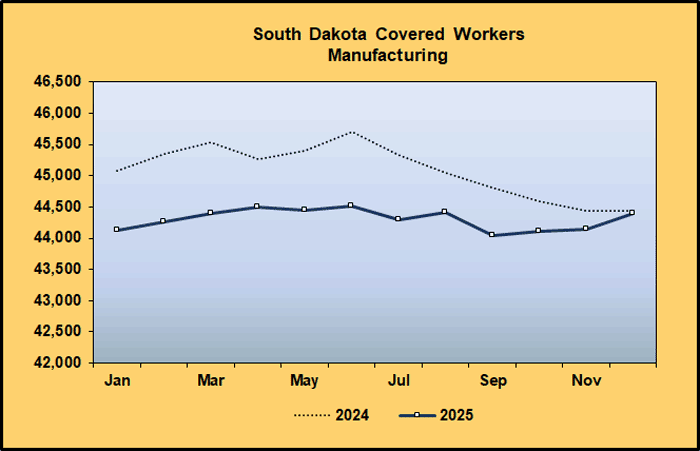
The Manufacturing sector’s employment level decreased by 785 workers (1.7%) to a total of 44,302 in 2025. This sector comprises establishments that are engaged in the mechanical, physical, or chemical transformation of materials, substances, or components into new products. Businesses are involved in durable and nondurable goods manufacturing. Establishments included in durable goods manufacturing make goods with a normal life expectancy of three or more years. These items typically consist of higher dollar products, such as machinery, furniture, building materials, and electronic equipment. Non-durable goods typically consist of food and beverage, clothing, and paper products. These goods generally have normal life expectancy of less than three years.
There were eight subsectors that showed employment gain and 12 subsectors that showed employment loss during 2025.
Subsectors with increased worker levels listed in order of actual worker gain:
- Fabricated Metal Product Manufacturing (NAICS 332): 185 workers (4.2%)
- Wood Product Manufacturing (NAICS 321): 98 workers (4.8%)
- Nonmetallic Mineral Product Manufacturing (NAICS 327): 47 workers (2.6%)
- Chemical Manufacturing (NAICS 325): 27 workers (2.1%)
- Paper Manufacturing (NAIS 322): 25 workers (3.7%)
- Electrical Equipment, Appliance, and Component Manufacturing (NAICS 335): 14 workers (2.9%)
- Petroleum and Coal Products Manufacturing (NAICS 324): 1 worker (50.0%)
- Leather and Allied Product Manufacturing (NAICS 316): 1 worker (11.1%)
Subsectors that saw decreased worker levels in 2025:
- Transportation Equipment Manufacturing (NAICS 336): -308 workers (8.1%)
- Computer and Electronic Product Manufacturing (NAICS 334): -251 workers (13.1%)
- Food Manufacturing (NAICS 311): -225 workers (2.0%)
- Miscellaneous Manufacturing (NAICS 339): -167 workers (3.5%)
- Machinery Manufacturing (NAICS 333): -114 workers (1.9%)
- Textile Product Mills (NAICS 314): -40 workers (6.5%)
- Plastics and Rubber Products Manufacturing (NAICS 326): -24 workers (1.3%)
- Furniture and Related Product Manufacturing (NAICS 337): -23 workers (1.1%)
- Apparel Manufacturing (NAICS 315): -15 workers (26.3%)
- Beverage and Tobacco Product Manufacturing (NAICS 312): -11 workers (3.3%)
- Primary Metal Manufacturing (NAICS 331): -3 workers (0.5%)
- Printing and Related Support Activities (NAICS 323): -2 workers (0.2%)
Not included in the employment loss/gain lists was Textile Mills (NAICS 313). This subsector had no reported establishments or employment in 2025. Establishments in the Textile Mills subsector transform a basic fiber into a product, such as yarn or fabric that is further manufactured into usable items such as apparel, sheets, towels, and textile bags for individual or industrial consumption.
The Fabricated Metal Product Manufacturing subsector saw the largest employment growth in 2025. Establishments in this subsector transform metal into intermediate or end products. Important fabricated metal processes are forging, stamping, bending, forming, and machining, used to shape individual pieces of metal; and other processes, such as welding and assembling, used to join separate parts together.
The 2025 annual pay for the Manufacturing sector was $66,214, an increase of 4.4% compared to the 2024 level of $63,415. Annual pay increased in 17 of the 20 manufacturing subsectors. The five with the largest percentage increase are listed below.
- Apparel Manufacturing (NAICS 315): $5,071 (11.1%)
- Computer and Electronic Product Manufacturing (NAICS 334): $5,432 (9.4%)
- Plastics and Rubber Products Manufacturing (NAICS 326): $4,637 (7.4%)
- Paper Manufacturing (NAIS 322): $4,448 (6.7%)
- Wood Product Manufacturing (NAICS 321): $4,028 (6.7%)
While most of the Manufacturing sector had an increase in annual salary, pay fell in three subsectors:
- Beverage and Tobacco Products Manufacturing (NAICS 312): $1,371 (5.6%)
- Petroleum and Coal Products Manufacturing (NAICS 324): $761 (1.3%)
- Chemical Manufacturing (NAICS 325): $624 (0.8%)