- Home to LMIC
- Virtual Labor Market Data System
- Career Exploration & Planning
- Consumer Price Index
- Demographics
- Economic Snapshot
- Employee Benefits
- Employment Projections
- Labor Force & Unemployment
- Labor Supply
- Overview of the Current Labor Market
- Surveys We Conduct
- Wages & Income
- Workers by Industry
- Tools & Resources
- Publications
- References
- What's New
- Can't Find It?
Labor Market Information Center
2025 Annual Report
Quarterly Census of Employment and Wages
Natural Resources & Mining Supersector
The Natural Resources and Mining supersector is comprised of the Agriculture, Forestry, Fishing and Hunting sector and the Mining, Quarrying, and Oil and Gas Extraction sector. Examples of business activities in this supersector group include growing crops, raising livestock, managing farm services, logging, and extracting natural mineral solids at a mine site.
| South Dakota Covered Workers and Pay 2025 |
|||
| Supersector, Sector and Subsector | Number of Establishments | Average Number of Workers | Annual Pay |
| Natural Resources and Mining | 1,409 | 8,742 | $58,069 |
| Agriculture, Forestry, Fishing, and Hunting | 1,316 | 7,629 | $53,523 |
| Crop Production | 599 | 2,238 | $48,729 |
| Animal Production and Aquaculture | 505 | 4,530 | $53,603 |
| Forestry and Logging | 20 | 78 | $51,562 |
| Fishing, Hunting, and Trapping | 7 | 12 | $57,873 |
| Support Activities for Agriculture and Forestry | 185 | 770 | $67,186 |
| Mining, Quarrying and Oil and Gas Extraction | 93 | 1,113 | $89,229 |
| Oil and Gas Extraction | 2 | 22 | $115,493 |
| Mining, except Oil and Gas | 57 | 957 | $84,543 |
| Support Activities for Mining | 34 | 134 | $118,387 |
| Totals may not add due to rounding. Data subject to revision. Produced by the Labor Market Information Center, South Dakota Department of Labor and Regulation, in cooperation with the U.S. Bureau of Labor Statistics. |
|||
Agriculture, Forestry, Fishing and Hunting
NAICS Sector 11
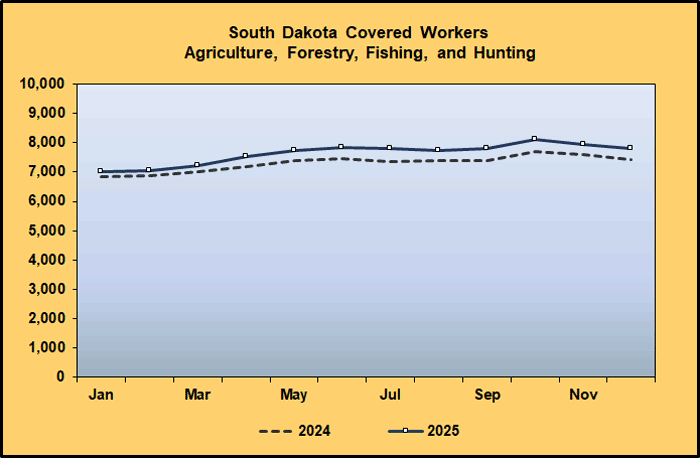
The Agriculture, Forestry, Fishing and Hunting sector increased over the year, with the addition of 326 workers (4.5%) in 2025. The annual average employment reached 7,629 workers. The annual pay for 2025 was $53,523, an increase of $2,201 or 4.3% compared to 2024.
Most individuals employed in Agriculture, Forestry, Fishing and Hunting are considered 'non-covered' (not covered by unemployment insurance) and are therefore not counted in the Quarterly Census of Employment and Wages (QCEW) program. If the non-covered employment were included, this sector would be one of the largest industries in South Dakota in terms of employment.
According to the Bureau of Labor Statistics (BLS), the QCEW monthly employment data represents the number of covered workers who worked during or were paid for the pay period including the 12th day of the month. The program excludes proprietors, the unincorporated self-employed, unpaid family members, certain farm and domestic workers, and railroad workers covered by the railroad unemployment insurance system.
Between 2024 and 2025, four subsectors under the Agriculture, Forestry, Fishing and Hunting sector reported gains, while one decreased in workers.
- Crop Production increased by 55 workers (2.5%)
- Animal Production and Aquaculture increased by 261 workers (6.1%)
- Forestry and Logging decreased by 8 workers (9.3%)
- Fishing, Hunting, and Trapping increased by 5 workers (71.4%)
- Support Activities for Agriculture and Forestry increased by 11 workers (1.4%)
Some percentage changes are volatile due to low employment numbers. For example, the Fishing, Hunting, and Trapping subsector had only 12 workers as of 2025, so a small decrease leads to a large percentage change. The actual worker numbers by subsector from largest to smallest are Animal Production and Aquaculture (4,530), Crop Production (2,238), Support Activities for Agriculture and Forestry (770), Forestry and Logging (78), and Fishing, Hunting, and Trapping (12).
Establishment levels showed modest growth as well as a gain of 37 establishments, growing from 1,279 in 2024 to 1,316 in 2025.
All subsectors showed increases in annual wages with the exception of Fishing, Hunting, and Trapping, which decreased $11,359 or 16.4%. Support Activities for Agriculture had the largest wage increase at $3,088 or 4.8%. Animal Production increased $2,621 or 5.1%, Forestry and Logging rose $1,484 or 3.0%, and Crop Production increased $1,216 or 2.6%.
Overall employment in Agriculture, Forestry, Fishing and Hunting increased modestly in 2025 with a few minor declines, mainly spread throughout the industry groupings. Positive gains were seen in Cattle Ranching and Farming, Oilseed and Grain Farming, Poultry and Egg Production, and Support Activities for Animal Production industry groups. Advances in technology and improved farming efficiency continue to reduce the need for field workers, but overall employment levels remain stable.
Mining, Quarrying, and Oil and Gas Extraction
NAICS Sector 21
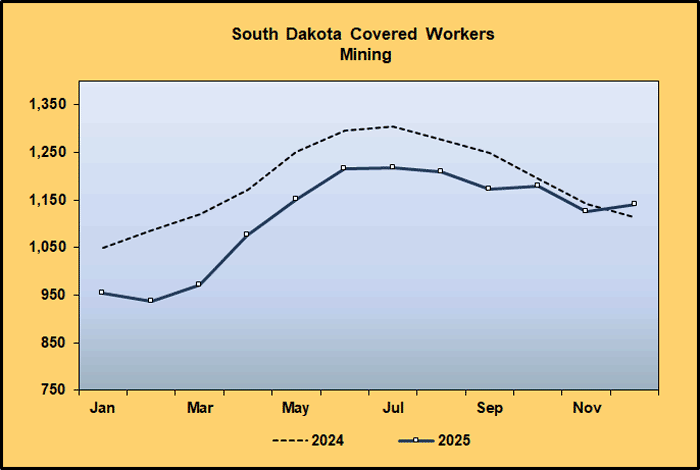
The Mining, Quarrying, and Oil and Gas Extraction sector lost 76 workers or 6.4% between 2024 and 2025, bringing the total employment to 1,113 workers. At the subsector level, one subsector gained workers while two lost workers. Average annual pay for the sector decreased by $3,235 or 3.5% to $89,229 in 2025. This sector ranked fifth among the higher-paying industries.
According to the United States Geological Survey (USGS), South Dakota has 1,128 records of mines listed. Mines are most prevalent in Custer (381), Lawrence (353), Pennington (155), Meade (97) and Harding (88) counties.
The Oil and Gas Extraction (NAICS 211) subsector maintained their two establishments but saw employment decrease by one worker or 4.3%. This subsector includes establishments engaged in operating and developing oil and gas field properties and recovering liquid hydrocarbons from oil and gas field gases. Annual pay declined by $7,938 or 6.4%. Given the subsector’s relatively small size and the temporary nature of many jobs, minor changes have a significant percentage impact.
The Mining (Except Oil & Gas) subsector (NAICS 212) added 16 workers or 1.7% and one establishment. Activities include mining, mine site development, and preparing metallic and nonmetallic minerals, including coal. The average annual pay increased by $1,848 or 2.2% to $84,543 in 2025.
The Support Activities for Mining (NAICS 213) subsector lost 91 workers or 40.4%, reducing total employment to 134 workers. This subsector provides contract or fee-based support services required for mining, quarrying, and oil and gas extraction, including exploration activities like prospecting and core sampling. Annual pay decreased by $11,767 or 9.0%. This subsector is highly volatile and can experience significant seasonal fluctuations. It gained two establishments in 2025.
According to the United States Geological Survey (USGS), the minerals mined in South Dakota are mica, construction sand and gravel, crushed stone, dimension stone, felspar, gemstones, gold, gypsum, industrial sand and gravel, lime, and silver. Staffing in the Mining, Quarrying, and Oil and Gas Extraction sector rises and falls with mineral production needs and is closely tied to activity in the Construction sector. For example, when demand for construction sand and gravel increases, the demand for workers in the Mining, Quarrying, and Oil and Gas Extraction sector also rises to meet higher production needs.