
- Home to LMIC
- Virtual Labor Market Data System
- Career Exploration & Planning
- Consumer Price Index
- Demographics
- Economic Snapshot
- Employee Benefits
- Employment Projections
- Labor Force & Unemployment
- Labor Supply
- Overview of the Current Labor Market
- Surveys We Conduct
- Wages & Income
- Workers by Industry
- Tools & Resources
- Publications
- References
- What's New
- Can't Find It?
South Dakota e-Labor Bulletin
April 2026
Nonfarm employment trends in 2025
Unless otherwise noted, the following highlights are based on a comparison of annual average data for 2024 and 2025.
South Dakota added 1,600 nonfarm wage and salaried workers (0.3%) in 2025, reaching 469,400. Growth was spread throughout many industries in the state. The Sioux Falls Metropolitan Statistical Area (MSA) added 2,100 workers (1.2%) for a 2025 annual average of 182,500 workers. The Rapid City MSA added 1,110 workers (1.5%).
| Nonfarm Wage & Salaried Workers by Industry (Not Seasonally Adjusted) | ||||
| Industry | 2024 Annual Average |
2025 Annual Average | Actual Change | Percent Change |
| Total Nonfarm | 467,800 | 469,400 | 1,600 | 0.3% |
| Total Private | 385,800 | 387,600 | 1,800 | 0.5% |
| Goods Producing | 75,600 | 75,000 | -600 | -0.8% |
| Service Providing | 392,200 | 394,400 | 2,200 | 0.6% |
| Mining, Logging & Construction | 30,500 | 30,800 | 300 | 1.0% |
| Manufacturing | 45,100 | 44,200 | -900 | -2.0% |
| Wholesale Trade | 22,500 | 22,300 | -200 | -0.9% |
| Retail Trade | 54,000 | 53,900 | -100 | -0.2% |
| Transportation, Warehousing & Utilities | 16,000 | 16,300 | 300 | 1.9% |
| Information | 5,100 | 5,000 | -100 | -2.0% |
| Financial Activities | 27,500 | 27,400 | -100 | -0.4% |
| Professional & Business Services | 37,300 | 37,200 | -100 | -0.3% |
| Private Education & Health Services | 79,000 | 80,300 | 1,300 | 1.6% |
| Leisure & Hospitality | 50,300 | 51,400 | 1,100 | 2.2% |
| Other Services (except Public Administration) | 18,500 | 18,700 | 200 | 1.1% |
| Government | 82,000 | 81,800 | -200 | -0.2% |
Note: Numbers may not add due to rounding. Source: Labor Market Information Center, South Dakota Department of Labor and Regulation, in cooperation with U.S. Bureau of Labor Statistics |
||||
Nonfarm industries can be divided into two major components:
- Goods Producing - Mining, Logging, and Construction sector and the Manufacturing sector)
- Service Providing industries (all other sectors listed in the table above)
Worker levels in Goods Producing decreased by 600 workers (0.8%) from 2024 to 2025. Service Providing industries gained 2,200 workers (0.6%).
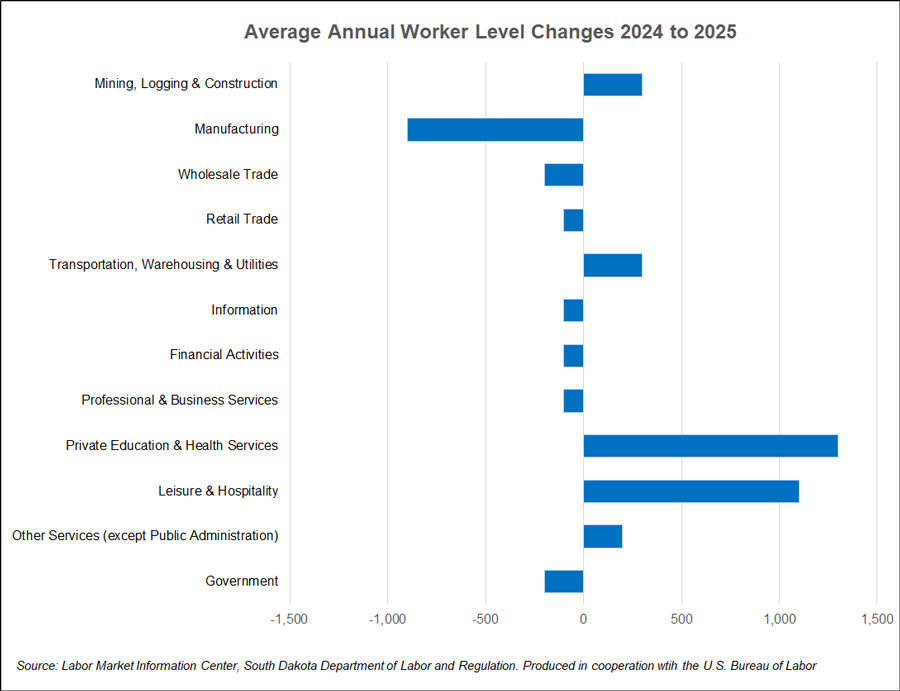
Mining, Logging and Construction added 300 workers (1.0%) in 2025, reaching 30,800. Mining and Logging lost 100 workers (7.7%) but has been very stable with only modest annual changes over the last 10 years.
Construction accounted for the growth, adding 500 workers (1.7%). Growth was concentrated in Specialty Trade Contractors and Heavy and Civil Engineering Construction, adding 300 workers each with 1.7% and 6.5% rates of growth, respectively. Combined, these two subsectors account for 76% of Construction employment. Specialty Trade Contractors perform a specific activity, such as site preparation, pouring concrete, plumbing, painting, and electrical work. General contractors increasingly subcontract with specialty trade contractors to ensure licensing and inspection requirements are met, manage project risks, access specialized skills, and improve efficiency.
Heavy and Civil Engineering Construction involves building and maintaining roads, bridges, and other infrastructure. Construction of buildings remained unchanged over the year with 7,200 workers.
Several factors have increased the demand for construction work. These include growing population, favorable business environment, company expansions, and ongoing investments in housing and infrastructure. For example, Smithfield Foods announced plans for a new $1.3 billion Sioux Falls facility to be built over the next three years. The new plant is expected to employ about 3,000 workers and be able to slaughter about 20,000 hogs a day. This is just one example of what drives construction demand.
Manufacturing worker levels declined slightly for the second year in a row (down 900 workers, 2.0% in 2025) after uptrending the prior two years. Non-Durable Goods Manufacturing declined 400 workers (2.3%), landing at 16,800 workers in 2025. Non-durable goods are immediately consumed in one use or have a lifespan of less than three years, such as food and beverage products, and paper products. Animal slaughtering is also included. A few specific examples of South Dakota-made non-durable goods are dairy products, meats including beef, pork, turkey, and related products like jerky, pet food, and paper-based packaging materials.
Durable Goods Manufacturing had a loss of 600 workers (2.1%). Durable Goods accounts for just under 62% of the Manufacturing workforce. Durable Goods produced in South Dakota, such as trailers, furniture, and electronic equipment, are not immediately consumed and can be kept for a longer time. The demand for workers within manufacturing is influenced by factors such as automation, slower demand for the goods being produced, and competition from other manufacturers.
Wholesale Trade worker levels trended down for the first time since 2020 with a small loss of 200 workers (0.9%). This industry sells products in bulk to other businesses. When manufacturing slows, wholesale trade often declines as well.
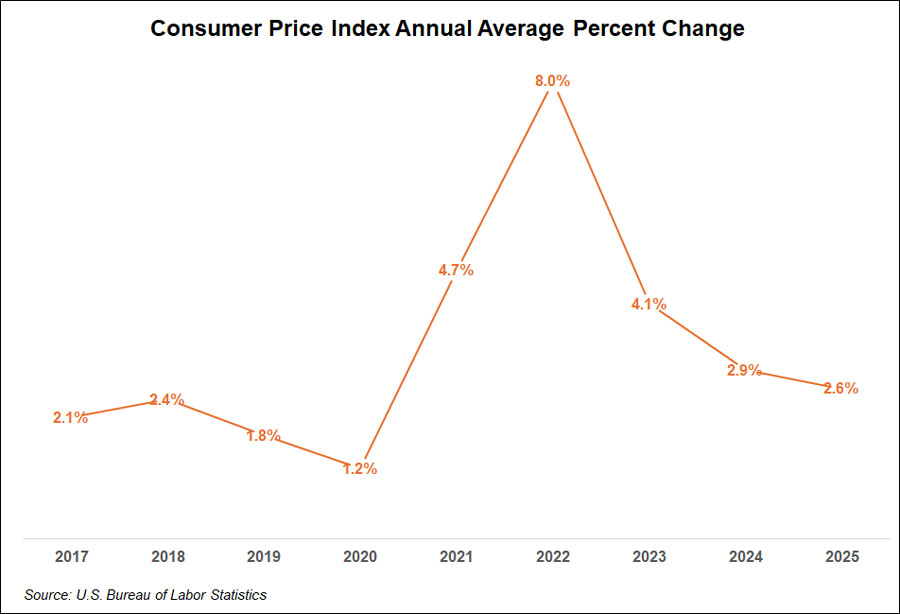
Retail Trade showed a slight loss of 100 workers (0.2%), falling to 53,900 in 2025. Retail trade businesses employ many part-time workers, often balancing their schedules with school or a second job. Clothing boutiques, home furnishing stores, department stores, hardware stores, supermarkets, gasoline stations, antique shops, and souvenir stores are examples of establishments in this sector. Some key factors that affect demand for these products and thus employment levels are consumer spending and behavior, advancements in technology, online competition, and prices. Although prices rose more slowly in 2025 than in previous years, shoppers continue to be price conscious.
Transportation, Warehousing, and Utilities grew by 300 (1.9%), reaching an annual average of 16,300 workers in 2025. This industry includes trucking, warehousing, towing, air travel services, electric power distribution, and natural gas distribution. Transportation and Warehousing benefit from South Dakota’s geographic location and its interstates and rail systems available for moving goods and products across the United States. Employment levels rely on the demand for those goods and the need to distribute or store products. Growth in Utilities is dependent on business expansion and population increases. South Dakota’s population continues to slowly but steadily increase. According to the U.S. Census, South Dakota’s population increased 1.1% to 935,094 in 2025.
The Information sector had a loss of 100 (2.0%) workers, landing at 5,000 workers in 2025. This sector includes traditional print publishers, internet publishers, motion picture and sound recording companies, broadcasting companies, movie theaters, internet service providers, data processing firms, and all other information services. Technology, consumer preferences, and consolidations have all played a role in the continued downward employment trend in the Information Sector.
Financial Activities declined by 100 (0.4%), dropping to an annual average of 27,400 workers in 2025. This supersector consists of the Finance and Insurance sector and the Real Estate and Rental and Leasing sector. Credit card banks, saving institutions, portfolio fund management, and insurance claims adjusting are examples of establishments. Efficiencies gained from consolidations, adoption of technology, and centralized functions reduce the workforce needs at physical branch locations. Employment in Financial Activities has been declining over the past five years.
Professional and Business Services worker levels showed a small decrease of 100 (0.3%) from 2024 to 2025. This supersector is broken down into the following sectors:
- Professional, Scientific, and Technical Services
- Management of Companies and Enterprises. and
- Administrative and Support and Waste Management and Remediation Services
This industry provides a wide range of services typically sourced by other businesses, occasionally provided to households. Examples of services provided are computer hardware consulting, payroll processing, landscaping, tax preparation, security, and corporate management. Technology has changed the way many businesses in this industry operate and staff. Smaller businesses lacking the resources to employ workers with certain specialized skill sets outsource professional administrative, marketing, and technical roles, for example.
Private Education and Health Services showed one of the largest worker increases (1,300 workers, 1.6%) in 2025. The growth was concentrated in Health Care and Social Assistance, specifically, which added 1,300 workers (1.8%). This group includes dentist offices, chiropractors, childcare centers, assisted living facilities, and vocational rehabilitation agencies. Hospitals showed a slight decrease of 100 workers (0.3%), landing at 28,500 workers for 2025. Demand for health services continues to rise due to both population growth and a larger share of older adults. Based on U.S. Census Bureau data, 18.8% of South Dakotans were 65 or older in 2025.
Educational Services added 200 workers (2.7%), climbing to 7,700 in 2025. These establishments provide instruction and training in a wide variety of subjects.
Leisure and Hospitality worker levels trended up by 1,100 workers (2.2%) to a new level of 51,400 in 2025. This supersector includes hotels, restaurants, museums, fitness centers, amusement parks, and performance venues. Tourism plays a significant role, with employment levels directly related to visitor levels. According to Tourism Economics, 14.97 million visitors traveled to and within South Dakota in 2025, an increase of 0.4% from 2024. Those visitors spent $5.16 billion, representing a 1.1% increase over 2024 and reinforcing tourism’s role as a stable contributor to the state’s economy.
Other Services (except Public Administration) gained 200 workers (1.1%) and reached a new level of 18,700 in 2025. This sector includes personal and repair services such as hair salons, nail salons, car washes, social clubs, auto repair shops, and pet boarding. Growth was related to rising consumer demand, increasing population, and economic conditions.
Government decreased 200 workers (0.2%) from 2024 to 2025. Local Government added 100 (0.2%) over the year, concentrated in Educational Services. Local Government growth reflects rising populations and increased demand for services including infrastructure, public safety, utilities, and schools.
State Government worker levels held steady at 18,300, while State Government Educational Services remained constant at 9,200. Federal Government declined 300 workers (2.6%) as a result of funding reductions in certain departments.