
- Home to LMIC
- Virtual Labor Market Data System
- Career Exploration & Planning
- Consumer Price Index
- Demographics
- Economic Snapshot
- Employee Benefits
- Employment Projections
- Labor Force & Unemployment
- Labor Supply
- Overview of the Current Labor Market
- Surveys We Conduct
- Wages & Income
- Workers by Industry
- Tools & Resources
- Publications
- References
- What's New
- Can't Find It?
LMI Fact Checking

LMI Fact Checking: Seasonal Adjustment
True or False?
To show the impact seasonal events like winter weather has on employment levels, it is best to use seasonally adjusted data.
False!
The process of seasonally adjusting data removes the impacts of seasonal events like winter weather.
Over the course of a year, employment levels undergo sharp fluctuations due to such seasonal events as changes in weather, harvest, major holidays and the opening and closing of schools. Because these seasonal events follow a fairly regular pattern each year, their influence on statistical trends can be eliminated by adjusting the statistics from month to month. Seasonal adjustments make it easier to observe underlying trends that are more truly economic—such as cyclical trends and other nonseasonal movements in a data series.
The graph below illustrates the impact of seasonal adjustment, using monthly South Dakota labor force estimates for 2025. The blue line shows actual labor force levels each month. As you can see, the size of the labor force was at its lowest point in January and peaked in June. A January low is typical for South Dakota, related in part to the coldest weather. For example, cold January temperatures hamper many types of construction work. January also commonly brings employment declines in retail trade following the holiday shopping season. Meanwhile, the size of the labor force generally peaks in the summer when construction and tourism activity are the highest.
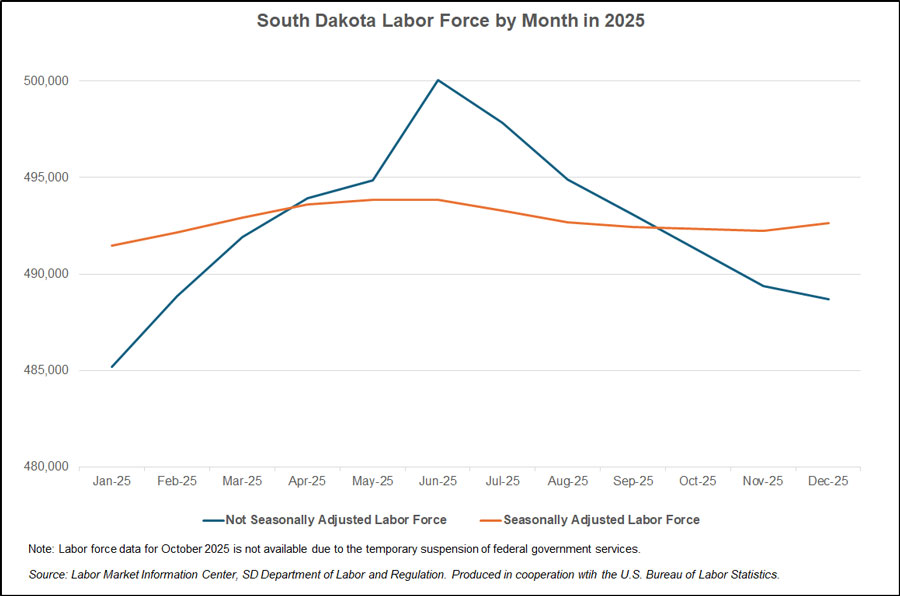
The orange line in the graph above displays the seasonally adjusted labor force estimates each month. As you can see, it is a much smoother line, with the sharp fluctuations from month to month removed through seasonal adjustment process.
Seasonally adjusted data is available for the following in South Dakota:
- Labor force estimates (including employment and unemployment levels and the unemployment rate) for statewide South Dakota and the Metropolitan Statistical Areas (MSAs) of Rapid City and Sioux Falls.
- Nonfarm wage and salaried worker estimates (by industry) for statewide South Dakota.
The seasonally adjusted data for each of these series is available in the virtual labor market data system. For seasonally adjusted data, simply click in the check box beside "Seasonally Adjusted" appearing under "Refine Results." If you select areas for which seasonally adjusted data is not available, no data will appear in the table populated based on the selections you make.
For assistance using the virtual system or to obtain seasonally adjusted labor force or nonfarm data, please contact us.
Seasonal adjustment is also explained on our Definitions page.