
- Home to LMIC
- Virtual Labor Market Data System
- Career Exploration & Planning
- Consumer Price Index
- Demographics
- Economic Snapshot
- Employee Benefits
- Employment Projections
- Labor Force & Unemployment
- Labor Supply
- Overview of the Current Labor Market
- Surveys We Conduct
- Wages & Income
- Workers by Industry
- Tools & Resources
- Publications
- References
- What's New
- Can't Find It?
South Dakota e-Labor Bulletin
October 2026
The Nitty Gritty of Occupational Demand
In last month’s article, we discussed occupational employment growth projected through 2034, focusing on the fastest-growing occupations. However, growth is only one part of future workforce demand. In fact, when estimating how many workers will be needed in the years ahead, growth typically plays a smaller role than separations.
Occupational demand is measured as job openings and has two components: employment growth and the need for replacement workers due to separations. The separation component includes both workers who transfer to different occupations and those who permanently exit the labor force. A transfer occurs when someone leaves one occupation for work in another, while an exit happens when a worker leaves the labor force entirely.
The table below shows the top 10 occupations projected to have the greatest annual demand (most job openings) for workers in South Dakota through 2034.
| Top 10 Occupations With the Highest Annual Demand in South Dakota for 2024-2034 | ||||||||
| Rank | Occupational Title | 2024 Employment | 2034 Employment | Numeric Change 2024-2034 |
Average Annual Openings | |||
| Employment Growth | Labor Force Exits | Occupational Transfers | Total Openings | |||||
| Total, All Occupations | 523,468 | 562,027 | 38,559 | 3,856 | 27,054 | 32,489 | 63,399 | |
| 1 | Fast Food and Counter Workers | 14,520 | 16,194 | 1,674 | 167 | 1,581 | 1,877 | 3,625 |
| 2 | Cashiers | 13,040 | 13,262 | 222 | 22 | 1,286 | 1,230 | 2,538 |
| 3 | Stockers and Order Fillers | 11,802 | 13,510 | 1,708 | 171 | 842 | 1,129 | 2,142 |
| 4 | Retail Salespersons | 13,593 | 14,515 | 922 | 92 | 936 | 1,060 | 2,088 |
| 5 | Waiters and Waitresses | 7,187 | 7,559 | 372 | 37 | 607 | 848 | 1,492 |
| 6 | Janitors and Cleaners, Except Maids and Housekeeping Cleaners | 9,455 | 10,342 | 887 | 89 | 699 | 689 | 1,477 |
| 7 | Bookkeeping, Accounting, and Auditing Clerks | 10,614 | 10,510 | -104 | -10 | 679 | 530 | 1,199 |
| 8 | Nursing Assistants | 6,565 | 7,040 | 475 | 48 | 449 | 488 | 985 |
| 9 | Registered Nurses | 14,208 | 16,133 | 1,925 | 192 | 428 | 326 | 946 |
| 10 | Customer Service Representatives | 6,956 | 6,838 | -118 | -12 | 388 | 511 | 887 |
| Source: Labor Market Information Center, South Dakota Department of Labor and Regulation, August 2026 | ||||||||
The methodology used for national and state employment projections is developed by the U.S. Bureau of Labor Statistics (BLS). This consistent approach ensures statistically sound, reliable, and comparable data across states. National projections for 2024–2034 were released in September 2025, followed by state projections in July 2026.
The BLS methodology incorporates both growth and separations data. Growth, however, is a rather minor portion of projected occupational demand. In this article, we will focus mainly on the separation component of demand. This separations methodology better reflects a dynamic labor market in which many workers change occupations over the course of their careers, some workers enter and leave the workforce temporarily multiple times, and eventually most exit permanently. Using historical data, patterns, and trends, the methodology accounts for two types of separations:
- Workers who leave the labor force entirely (shown above as Average Annual Openings due to Labor Force Exits).
- Workers who leave one major occupational group for another (shown as Average Annual Openings due to Occupational Transfers).
Certain trends shape how separations occur:
- Transfers are more common among younger workers exploring career options.
- Transfers are frequent in entry level occupations.
- Occupations with challenging working conditions—irregular hours, limited benefits, high stress, or physical demands—tend to experience more transfers.
- Labor force exits can happen at any age but are more common among older workers retiring.
How separations data shapes South Dakota’s occupational outlook through 2034
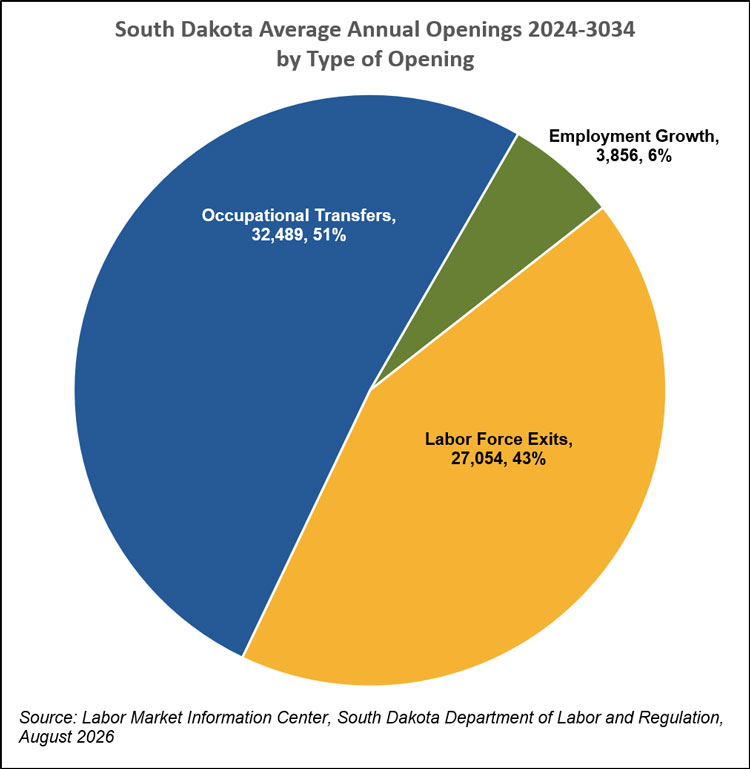
The pie chart below shows nearly all projected annual demand for workers in South Dakota from 2024–2034 will come from separations: 51.2% from transfers and 42.7% from labor force exits. Only 6.1% of openings will result from new job growth. This closely mirrors national trends, though South Dakota is expected to experience stronger employment growth. Nationally, transfers made up 54.0% and exits 43.2% of the annual demand for occupations, with 2.8% being caused by growth.
Labor Force Exits
In 2024, 48.5% of South Dakota’s civilian noninstitutionalized population age 55 and over participated in the labor force, up from 46.8% in 2022. According to the Current Population Survey conducted by the U.S. Census Bureau for BLS, this is an increase of 1.7% in the labor force participation rate of this age cohort from 2022 to 2024. Also, according to the CPS, the number of South Dakotans age 55+ was 283,000 in 2024, increasing by 12,000 people from 271,000 in 2022. It stands to reason that if both the labor force and population levels in this age cohort were higher in 2024, the number of labor force exits for this age group would also be higher. This, aligned with the fact that the last of the baby boom generation will reach retirement age during this projection’s decade, is what will cause the number of exits due to retirement to remain high. Retirement is the most common and permanent type of labor force exit.
But retirement is not the only reason workers leave the labor force. The other age group which tends to exit the labor force at a higher rate is the youngest one.
| Top 10 South Dakota Occupations with the Highest Annual Openings Due to Labor Force Exits 2024-2034 |
||
| Rank | Occupational Title | Annual Average Labor Force Exits |
| Total, All Occupations | 27,054 | |
| 1 | Fast Food and Counter Workers | 1,581 |
| 2 | Cashiers | 1,286 |
| 3 | Retail Salespersons | 936 |
| 4 | Stockers and Order Fillers | 842 |
| 5 | Janitors and Cleaners, Except Maids and Housekeeping Cleaners | 699 |
| 6 | Bookkeeping, Accounting, and Auditing Clerks | 679 |
| 7 | Waiters and Waitresses | 607 |
| 8 | Nursing Assistants | 449 |
| 9 | Home Health and Personal Care Aides | 437 |
| 10 | Registered Nurses | 428 |
| Source: Labor Market Information Center, South Dakota Department of Labor and Regulation, August 2026 | ||
Above is a table consisting of occupations with the highest annual demand openings due to labor force exits. But all occupations will lose employees due to workers exiting the labor force. So, what makes the occupations in this list more prone to workers exiting the labor force?
First, these jobs are found in some of South Dakota’s biggest industries: eating and drinking, the trade industry, and health care. Secondly, some of these jobs are found in nearly every industry in South Dakota. Think about bookkeeping, accounting and auditing clerks, and janitors and cleaners.
Secondly, what do each of these jobs have in common? They are all very labor-intensive, and the employers hiring these types of workers are often open 24/7, 365 days a year, and these positions are needed on nearly all shifts.
For this reason, some employers lean toward younger workers who have more stamina. Many of these workers also don’t mind working irregular shifts, weekends, and holidays. They also pick up the technological aspects of jobs more quickly and generally aren’t afraid to try new things. In addition, they generally have no physical limitations and can perform physical aspects of their duties with ease.
But there are trade-offs. Because younger workers are not tethered to earning a certain amount of money and often aren’t concerned about benefits, this group of workers is not as loyal as some of the other age cohorts. Some young workers accept a job without realizing the extent of commitment of time and energy and end up quitting—thus exiting the labor force. In other cases, young workers are still in school and leave a job when school resumes to maintain their studies and participate in extracurricular activities.
Employers of workers in occupations found on the highest demand due to exits list employ many of the state’s youngest and most experienced workers. Those ‘bookend age segments’ of the workforce probably have more in common than one might initially think. Like their young counterparts, many of the state’s older workers are not necessarily working to make a living but rather to supplement the way they want to live. Both age cohorts may also appreciate employee perks such as discounts on food, beverages, and merchandise. Unlike their younger counterparts, many older workers work primarily for benefits and tend to covet employment offering good health, vision, and dental insurance or benefits like employer-paid health clinics and vaccinations. They also see work as giving them purpose and a connection to community. Some older workers leave occupations that are stressful for a more carefree work environment or for more ‘fun’ work related to a personal interest or hobby. The social aspect of a job may hold appeal for interaction with other people, including younger co-workers.
Like younger workers, older workers tend to have a more limited work life. They may realize a job they’ve accepted is more physical or technical than expected and exit the labor force. They may leave the labor force when they no longer need the benefits and/or wages being offered. Sometimes health or family obligations change, prompting their exit from the labor force.
Realizing their employment may not be long-term, employers value both groups and find these workers essential to the success of their establishment. They’re willing to provide flexible scheduling and invest in training them to make their tenure in the labor force successful.
Not all labor force exits are by the younger and older workers. Exits occur for a variety of reasons. For example, some leave the labor force for family-related events such as a move triggered by another family member’s job move or loss, a divorce, or death of a family member.
Other reasons workers often cite for exiting the labor force are related to family obligations. Some examples include caring for an aging or ill family member, caring for young children, and/or home-schooling family members. Regardless of the reason, when a worker leaves the labor force, the exit creates an occupational opening.
Some labor force exits are one-time events and permanent, while labor force attachment is transient in other cases. By this we mean workers who regularly jump in and out of the labor force during different seasons in their lives. Reasons include family obligations like raising young children, taking care of aging relatives, or accommodating a partner’s career. Some experience frequent moves and therefore bounce in and out of the labor force routinely.
Looking at the table of occupations with the highest demand due to labor force exits, a few interesting observations can be made. First, all the occupations in the exits table require many workers and are either found in South Dakota’s biggest industries or are found across many industries. Secondly, most of these occupations are labor-intensive, requiring many workers and a relatively minimal amount of training. This makes for great opportunities for more mobile labor force participants. Jobs in these types of occupations are easier to find, and the skills required tend to be transferable from one employer to another.
Registered nurses make this top 10 list because there are a lot of jobs available for nurses. The health industry is large, and it is found in almost any location. There is a training curve, and these workers do need to be licensed in the state they work. However, once these workers have been trained and have their license, finding employment is generally fairly easy. And, though every work environment is different, the skills they have gained from one employer often make them more desirable to the next employer. Another reason for the high number of exits in this occupation, however, is simply because these workers are by nature caregivers and family-oriented. So, when a family situation arises, they are often the ones who put their career on the back burner for a time to meet family obligations. In addition, this occupation also is a high stress occupation, and the burnout rate is higher than many other occupations. So, it is more common for these workers to exit this occupation for a time to recharge their batteries or retire at an early age.
Occupational Transfers
Occupational transfer measures worker attachment to a particular occupation. This component of occupational demand has become more important in more recent years than in the past, when it was more commonplace for individuals to remain in the same occupation throughout their working years.
| Top 10 South Dakota Occupations with the Highest Annual Openings Due to Occupational Transfers 2024-2034 |
||
| Rank | Occupational Title | Annual Average Occupational Transfers |
| Total, All Occupations | 32,489 | |
| 1 | Fast Food and Counter Workers | 1,877 |
| 2 | Cashiers | 1,230 |
| 3 | Stockers and Order Fillers | 1,129 |
| 4 | Retail Salespersons | 1,060 |
| 5 | Waiters and Waitresses | 848 |
| 6 | Janitors and Cleaners, Except Maids and Housekeeping Cleaners | 689 |
| 7 | Bookkeeping, Accounting, and Auditing Clerks | 530 |
| 8 | Customer Service Representatives | 511 |
| 9 | Nursing Assistants | 488 |
| 10 | Receptionists and Information Clerks | 419 |
| Source: Labor Market Information Center, South Dakota Department of Labor and Regulation, August 2026 | ||
Both occupational exit and transfer occupations tend to be held by similar demographic pools in the labor force. Generally, both exit and transfer openings are created by the younger and older members of the labor force. Women tend to make up a larger portion of these openings than men. Many workers on the top 10 transfer table favor part-time, seasonal work, or work for a limited time in a particular occupation. Some of these workers hold more than one job at a time, and some prefer to work alternate work schedules (swing, graveyard, early morning, weekend, or holiday shifts). Workers in ‘transfer occupations’ generally prefer irregular work schedules more than those in ‘exit occupations.’
Occupations with high demand due to workers transferring out of them tend to be labor-intensive positions with many job openings. For the most part, these occupations are quickly learned and can be found in both cities and more rural areas. Workers can find either part-time or full-time positions as well as a variety of work schedules to fit their needs. To fill positions, most employers are flexible and willing to work around employee scheduling needs. Most employees who take these positions are not interested in making it their life’s work and are employed for a finite amount of time.
Many of the occupations found on the highest occupational transfers list are the same as those on the high exits list: fast food and counter workers, cashiers, retail salespersons, stockers and order fillers, waitresses and waiters, and janitors and cleaners. Again, they are large occupations with high employment levels, so proportionately, it makes sense they also have a large number of openings, many of which are due to occupational transfers. In other cases (such as with customer service representatives), not only is there extensive employment, but the occupations are found throughout a wide variety of industries.
Like workers who exit the labor force, workers who transfer out of the occupations on the high transfer list often work for a finite amount of time. But, unlike those who exit the labor force altogether, these workers create openings when they accept employment in a completely different occupation. It’s not just changing from one position within a company to another position within the same occupation or even transferring from one company to another in the same occupation. An opening caused by an occupational transfer is created when a worker becomes employed in a completely different occupation. An example would be someone working as a retail salesperson in a department store while taking courses to become a network security specialist and who, upon completion of the program, accepts a position as a network security specialist. The position left open, the retail salesperson’s job, would be an occupational opening due to a transfer. And it doesn’t matter if the new position accepted was with the same employer or a different one.
In some cases, occupations on the high occupational transfer list (like bookkeeping, accounting, and auditing clerks and nursing assistants) are stepping-stone occupations. The entry requirements and work schedules may be a good fit for workers over the short term. Over the longer term, workers may seek additional education and advance their career into higher-level occupations such as accountants or nurses. With more education and/or work experience, customer service representatives may be promoted to administrative or mid-level management positions.
In other cases, working conditions and responsibility demands which are not a good fit for the worker’s personality cause higher burnout and cause workers to seek opportunities in other occupations. For example, a customer service representative position where ‘cold calls’ are required may not be a good fit for someone who is timid. Likewise, one who doesn’t like conflict would probably not be employed long-term as a customer service representative constantly fielding customer complaints.
Want more information?
The projected occupational demand information to 2034 recently completed for 585 detailed occupations in South Dakota is available on the South Dakota Department of Labor and Regulation (DLR) website. Please visit the LMIC website’s Employment Projections by Occupation menu page for data options, plus links for related occupational descriptions and technical notes about the projections.